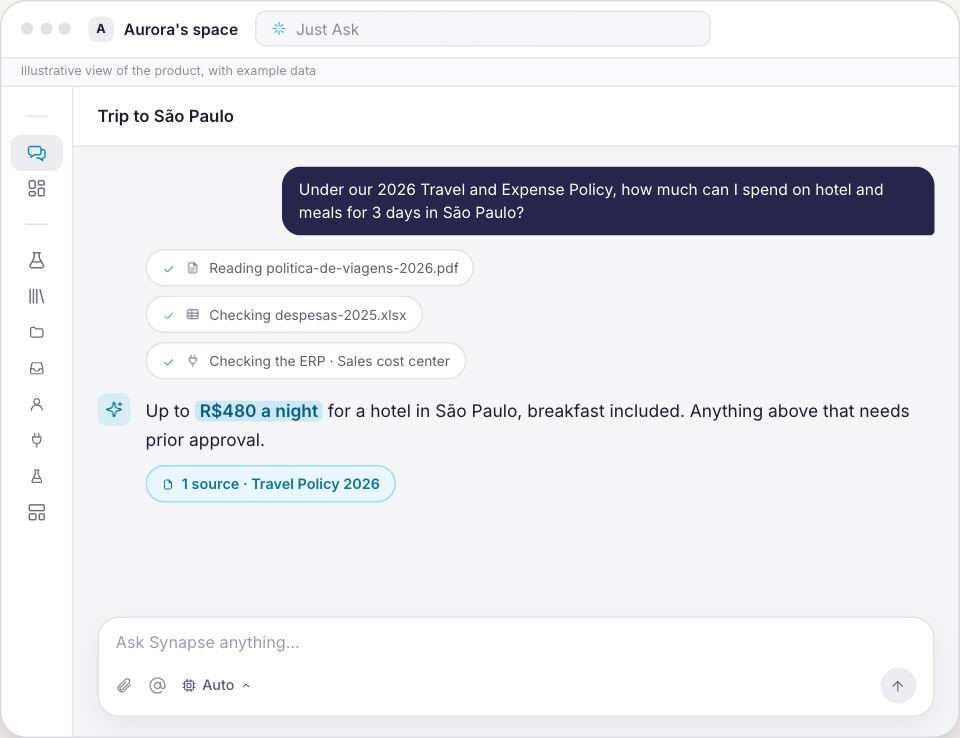
The material your company already has comes into the conversation, the work that repeats runs on its own on the board, and the step that changes something outside waits for a person, all inside the same space.
Registration and certificates when the case opens, two comparable quotes, and the area manager's sign-off before the order.
buying-policy.pdf, page 4approved-suppliers
With Synapse
From the company's material to the work delivered.
Scroll and watch the same space change screens, one chapter at a time.
Chat
The question meets the company's own material
Someone asks in the words they use every day and the answer comes from what the company has already written, with the document and the page in plain view to check on the spot.
The answer shows where it came from
A document you may not open never reaches your answer
Chat
The material goes in once and serves everyone
Contracts, policies, spreadsheets and even the recording of a meeting sit in a Knowledge Base folder, and the conversation starts answering from that folder.
Document, spreadsheet and audio in one place
The folder is the conversation's context
Chat
The tables in your systems answer too
The tables your company already maintains arrive through a ready-made connector or the API and are read where they live, instead of becoming a copy nobody trusts.
The source is read, never changed
The chart comes out of the same question
Task Board
The work that repeats runs on its own
What happens every week starts happening without anyone remembering it, and the team finds the draft waiting when they sit down.
Every run shows what went in and what came out
A person gets the result, not the chore
Task Board
The decision stays with a person
When the next step leaves the company it stops and waits for whoever answers for it, with the reason in plain view of the person deciding.
Approve, adjust or send it back
Who decided what stays on the record
A foundation that connects the company, from information to application
Synapse connects what your company knows to what it needs to get done. By bringing documents, spreadsheets, systems and conversations into a shared context, it lets every area build on what the others have learned. So the second area starts faster than the first, backed by the experience of the whole company. Every new application makes that foundation stronger, speeding up decisions and adding value across the organization.
06Channels and experience
Chat, dashboards and channels carry the applications to people, inside each team's routine.
05Agents and teams
Agents work together on the tasks, with people leading the decisions and the exceptions.
04Rules and flows
Processes gain a sequence and a context, respecting the company's rules and approval points.
03Intelligence
AI models give the agents their capability, with the choice configured for each application.
02Integrations
Systems, databases and APIs connect to the platform, within the scope agreed for each integration.
01Data and knowledge
The tables in your systems and the knowledge base bring spreadsheets and documents together, giving the applications their context.
Governance
Permissions, human approval and traceability follow the work across every layer.
Security
Access controls and credential protection are part of the architecture, with data conditions assessed in each deployment.
How this starts in your company.
1
One process, not a programme
We pick together a process that takes your team's time today and start there.
2
The sources it uses
The documents and tables that process already consults come in through a ready-made connector or the API.
3
The team uses it and you follow along
The people doing the work start finding the draft ready, and every step stays on the record.
A conversation about a process of yours.
Instead of a slide deck, we walk together through a piece of work your team does today.
With the people who will use it
What we do together
We start from a process in your company, not from a script.
We look at where that process keeps its documents and tables today
We show the question becoming an answer with the source in view
We point out the integrations it needs, ready-made connector or API
We mark where a person decides before anything goes out
No commitment, and you leave with the path mapped out even if you do not go ahead with us.
The company stays in control.
Who sees whatYour company's permissions hold inside Synapse, and a document someone may not open never reaches their answer.
Human approvalThe step that changes something outside waits for a person, and it is that person who approves, adjusts or sends it back.
A trail of every stepWhat was asked, what was used to answer it and who decided all stay on the record, for whenever someone needs to check.
Your systems stay yoursTables are read where they live, with no change at the source, and credentials are kept encrypted.
On TVBluey, the company behind Synapse, on TECH SC by Globo NSC
Questions that come up before you start
What happens in the demonstration?
We start from a process in your company to show how data, agents and human review take part in the work, and along the way the sources and integrations it needs come into view.
Do we have to replace the systems we already use?
No. You connect what is already in use, through a ready-made connector where one exists for that system or through the API, in both directions, and synced tables are read with no change at the source.
Where does the answer come from?
From the material you put in and the tables you connected, and it comes with the document and the page behind it, so you can check before you use it.
Who decides what the AI is allowed to do?
You do. Each person sees what their permission allows, any step that leaves the company can require approval, and the record shows who decided what.
How do we size the investment?
The proposal covers the platform scope, the AI usage and the support for adoption, and the requirements are assessed before anything is signed.
See Synapse in your own context.
Bring a process that takes your team's time and we walk through the sources, the agents and the decisions it asks for.