Ask as you’d ask the team
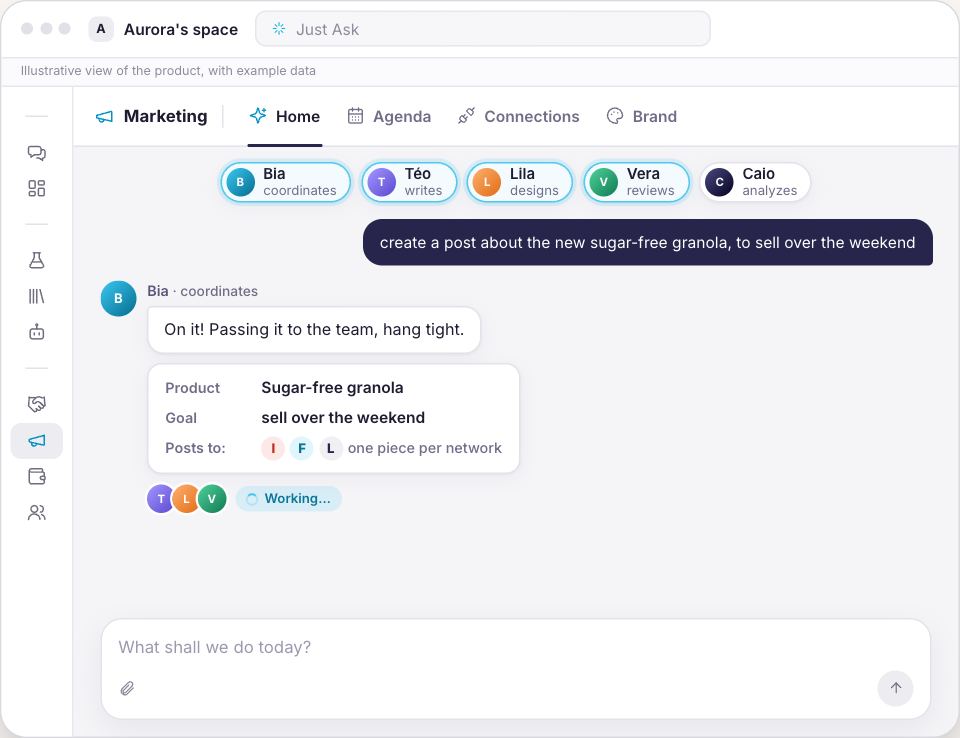
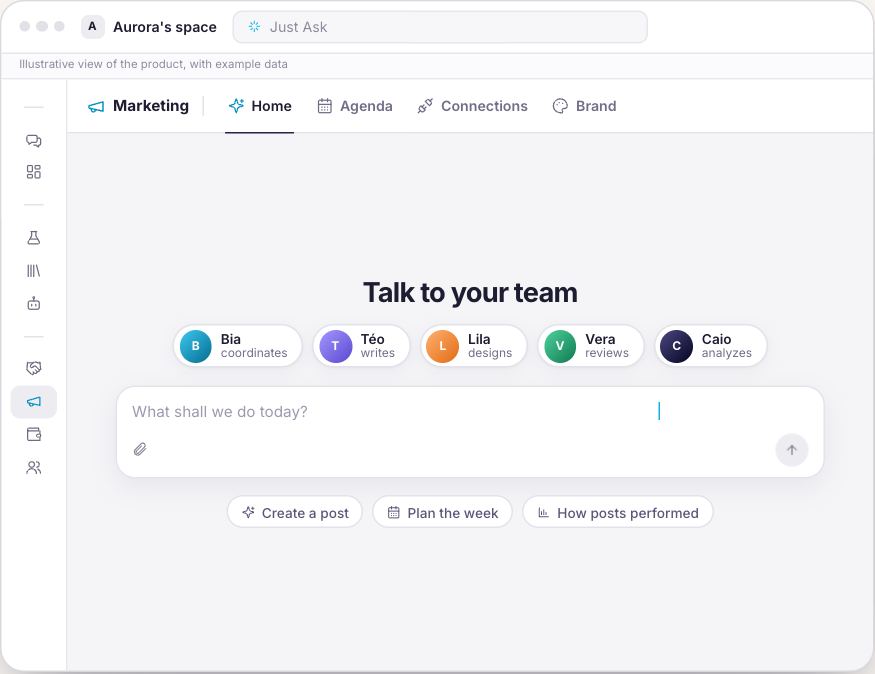
Talk to Bia as you would to someone on the team: she takes the request and passes it into the flow, no form.
Ask for the post the way you would ask a teammate. The text comes out in your brand's voice and the art in your colours, one piece for each connected network. Someone approves it before it goes out, publishing happens on its own at the scheduled hour, and the numbers come back from the networks themselves.
A brief in one sentence, the team writing and designing in your brand's DNA, approval before anything goes live, and the numbers straight from the network.

Drag the line and compare the week improvised with the week already on the calendar.
The Marketing module takes the request the way you’d ask a teammate, writes in the brand’s voice, makes the art, publishes to the networks and brings the numbers back — nothing goes live without approval.
Talk to Bia as you would to someone on the team: she takes the request and passes it into the flow, no form.
The AI writes in the brand’s voice and makes the art in your colors — ready for you to review, not to approve blind.
Instagram, Facebook, LinkedIn, blog and site: automatic publishing to the connected networks.
Approve or Reject, and every decision is logged. Nothing goes live without your approval.
Scheduled, it goes out on time on its own; or Publish now, whenever you want.
Caio reads the networks’ real numbers and suggests the next step; you apply it.
Every step happens on a screen you will find after signing up, under the same name it has in the menu.
Home is where the conversation with your content team lives. One sentence becomes a piece for each connected network, with the text in your brand's voice, the art in your colours and a suggested time on the calendar. Point at folders in the Knowledge Base and the text starts quoting what your company actually wrote, the price list or the product sheet, instead of generic copy.
Instagram and Stories, Facebook, LinkedIn, the WordPress blog and your own site publish on their own on connected accounts. TikTok is the case we would rather say upfront: until our app passes the platform's review, the account only allows a restricted post, and Synapse then refuses to publish with the reason written instead of posting something nobody would see.
Every piece carries a visible state on the calendar, from draft to published. You open the preview, approve or reject, and a rejected piece goes back to the team to be redone. Whoever works alone publishes directly, and the record keeps that it was a solo publication.
An approved piece enters the calendar and goes out on its own at the hour, with nobody online. When a network refuses, the reason comes written with its name and what it answered, and the piece keeps the button that sends it again. A passing failure is rescheduled on its own, with a growing wait.
Performance lives on the post itself, inside the calendar: reach on the calendar card, the full set on the list row, and a summary band above it, over a 7, 30 or 90 day window. The team's analyst reads those numbers and says what to repeat and what to adjust, and nothing changes in the planning without your click.
It is where the posts come out. Instagram and Facebook ask for the Meta login; LinkedIn and TikTok, the network's own authorization; the blog, a WordPress application password.
Colours, typography, tone of voice and forbidden terms. It is what the team writes and designs with, and every item says whether you confirmed it or the team inferred it.
One sentence is enough. The piece arrives ready for you to review, approve and leave scheduled.
Marketing brings the production, the approval and the publishing on connected networks, along with what comes in every door: chat, projects, templates and your business context.
For whoever answers for the brand's presence
You see the amount before confirming any charge.
You create the account and the company space, and the subscription opens next, with the option chosen here.
No lock-in. Cancel whenever you like and keep using it until the end of the paid period.
On TVBluey, the company behind Synapse, on Globo NSC's TECH SC
Instagram (feed and Stories), Facebook, LinkedIn, the WordPress blog and your own site, always on connected accounts. TikTok depends on the platform's review of our app: until it comes through, the account only allows a restricted post and Synapse refuses to publish with the reason written, instead of posting something nobody would see.
By default it goes out on the personal profile of whoever connected, and the card always says who will sign it. Publishing as a page depends on your account's authorization covering the pages you manage; without that, the screen explains why instead of sitting blank. On Facebook, publishing to a Page depends on the permission granted to the app.
Whoever holds the approval permission. You can set an approver per network and turn on the rule that whoever creates does not approve, which ships off. If you are the only person who publishes, reviewing and publishing is the same gesture, and the record keeps that it was a solo publication.
The piece comes back with the reason written, with the network's name and what it answered, and the try again button sits on the post itself. A passing failure is rescheduled on its own. And a post never goes out twice: the publishing path has three independent guards.
From the networks themselves, collected once a day and never estimated. What the network did not report shows as absent, not as zero, and there is a button to fetch right now without waiting for the daily collection.
If you point at it. Under Brand, the team material section links folders from the Knowledge Base, and from then on the team looks in them for the passages that bear on the subject. The permission of whoever asked for the post applies, and with no folder marked the team writes from the brand DNA.
No. The email surface was removed, and there is no mass sending and no WhatsApp broadcast: WhatsApp on the platform is a one to one conversation. The channels are the social networks, the blog and your site.
No. What exists is boosting a post that is already live, with budget and duration chosen from buttons: the spend comes out of your ad account, not platform credits, and the request goes to whoever answers for the budget.
No. Connecting a network is that network's login in a window, and the blog asks for a WordPress application password. The rest is asking for the post and approving it.

Connect a network, check your brand and ask for the first post. You approve before anything goes out.
Ask for the first post