Two files, the analysis begins
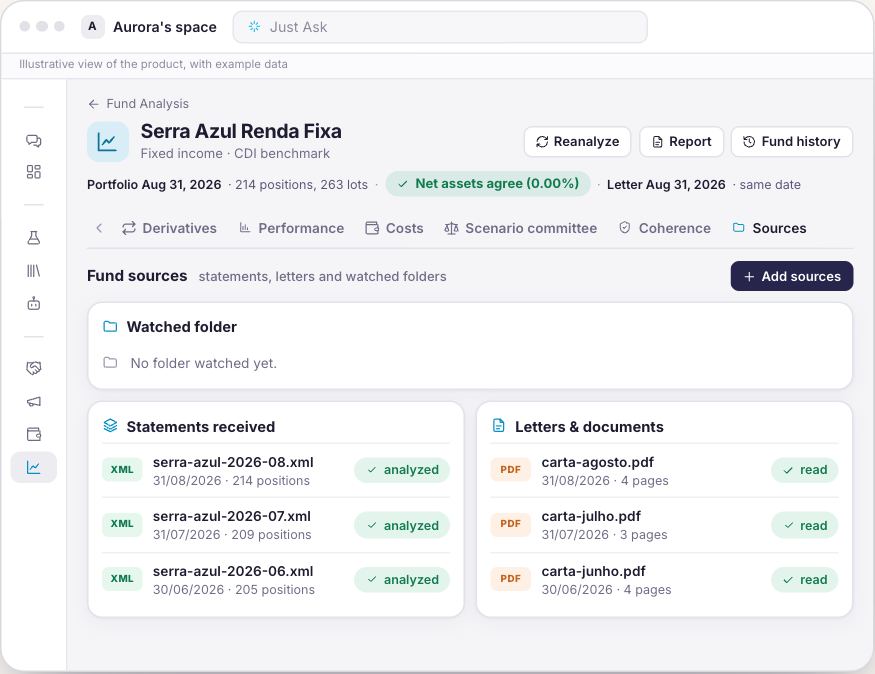
The fund’s portfolio in XML and the manager’s letter: with both, the analysis begins — no intermediate spreadsheet.
Point the fund at the folder where the custodian drops the statement and the manager drops the letter. The portfolio is reconciled before anything is read, what the letter claims is set against what the positions show, question by question, and the report goes to the committee. The AI interprets; it does not calculate: every figure comes from the statement or from a named public source.
Two files that become an analysis, the numbers that must add up before any reading, the question-by-question test, and the report that only goes out with your approval.

Drag the line and see the difference between rebuilding the pack by hand and asking the question with both pieces of evidence on screen.
The Funds module reconciles the portfolio and the manager’s letter, flags the discrepancies and leaves the questions ready for the analyst to review — the AI interprets; it does not calculate. Nothing is published without your sign-off.
The fund’s portfolio in XML and the manager’s letter: with both, the analysis begins — no intermediate spreadsheet.
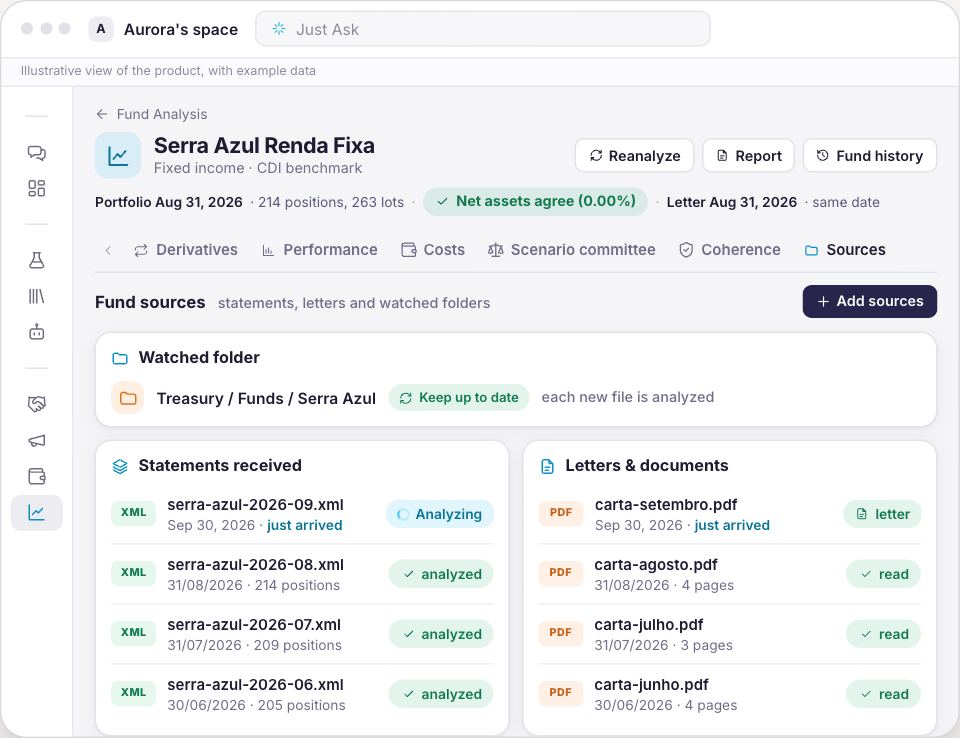
With "Keep updated", each month’s new file becomes analysis — with no one having to remember.
Before reading, the NAV checks out: declared equity × sum of positions. If it doesn’t match, the screen says so.
A question-by-question comparison of what the letter says and what the portfolio shows, with both pieces of evidence side by side.
Each number shows how it was made: from the file, from a rule or from the AI. The AI interprets; it does not calculate.
Approve and publish releases the nine-page report to the committee — nothing goes out without your sign-off.
Every step happens on a screen you will meet after signing up, under the same name it carries in the menu.
Point the fund at the knowledge base folder where the custodian drops the statement and the manager drops the letter. When the month's file appears, it is recognised and the analysis runs on its own. What decides which is which is the file itself.
The net assets declared in the file are checked against the sum of the positions it lists. They are two independent routes to the same figure, and the analysis only carries on with them reconciled.
The other tabs show the aggregate; Risk lines shows the arithmetic. Every position appears with its maturity, the rate that was used and the rate risk that came out of it, grouped by maturity bucket, with the duration and the multiplied value in plain sight so you can redo the sum by hand.
The market data screen shows the series the analysis consults and where each one came from. A source that answered in full reads differently from a source that fell short, and the second is never presented as the first.
The script ships ready and it is yours: the questions, the weight of each one and the bands are all configurable. Every line carries the verdict and both pieces of evidence, the quoted passage from the letter on one side and the computed figure from the portfolio on the other.
The analysis ends waiting for your approval. While nobody approves, the document is stamped as a draft; a reviewer sends a stage back with the reason, and the reason stays with the analysis for the next run to read.
The folder where the custodian drops the statement and the manager drops the letter. Or drag this month's two files in, if you would rather start with a single fund.
The declared net assets are set against the sum of the positions before anything is read, and what does not add up is flagged instead of slipping through.
Read the confrontation question by question, send it back with the reason if something did not convince you, and publish the report for the committee when it does.
The edition for allocators and fund selectors brings fund analysis and everything that comes with every door: chat, projects, the knowledge base and your business context.
For whoever answers for a shelf of funds
You see the amount before confirming any charge.
No lock-in. Cancel whenever you like and keep using it until the end of the paid period.
On TVBluey, the company behind Synapse, on Globo NSC's TECH SC, in the report on financial planning and longevity featuring the Elos caseWatch Bluey on TECH SC, Globo's technology programme, on financial planning and longevity, from 5:50
Elos released the name and the context, and not the figures: coverage, analyst hours and any measure of results appear neither here nor on any other page of this site.
The two the market uses today: the ANBIMA 4.01 layout and XML 5.0 of the ISO 20022 standard. The manager's letter comes in PDF, DOCX, TXT or Markdown. There is nothing to convert first, and both come in through the same door.
The net assets declared in the file are checked against the sum of the positions before anything is read. If the difference exceeds your tolerance, the statement is marked as not reconciled, the divergence is printed and it becomes an alert on the analysis, instead of entering the arithmetic in silence.
No. It measures one thing: whether what the letter claims and what the portfolio shows say the same thing. It is not a quality grade, not a verdict and not investment advice. The same portfolio and the same letter, read twice, do not always produce the same verdicts, which is exactly why every conclusion comes with the evidence from both sides for you to check.
The question stays out of the denominator, and the coverage is printed beside the number to qualify what it covers. When nothing could be assessed, because the letter is absent or silent on every theme, the platform shows a dash and the not-assessed mark on the dossier, the list, the history and the report.
From BACEN, CVM, ANBIMA, Tesouro Transparente and IBGE, and the screen shows which collector brought each figure and the date of the observation. ANBIMA's yield curve needs no credential; the index feed is a contracted source and stays pending until you configure your own credential.
Not if you point the fund at the folder the statement and the letter arrive in. When the month's file appears there, it is recognised and the analysis runs on its own. The watch sees with the eyes of whoever enabled it: if that person loses access to the folder, the source shows as unreachable instead of stopping in silence.
It can be watched, but today it is only detected: nobody has declared which column is the asset, which is the quantity and which is the price, so it does not become a portfolio. The sweep says so instead of staying quiet. A knowledge base folder works end to end.
No. The costs shown are the ones the statement itself provisions, not an audit of expenses. The net assets and costs page reports the net assets and what they cost; it does not break the variation down into causes.
You do. The script ships switched on and everything in it is configurable: the questions, the weight of each one, the value of each verdict and the score bands. Whoever configures the module also reads on screen, in full, the instructions each agent works under.
No, and it is not consultancy. The product confronts and evidences: it shows what the letter said, what the portfolio shows and where the two disagree. The decision is the committee's.

Point at the folder, let the check run, and take the question by question confrontation to the committee, with the evidence from both sides.
Review a fund